What if blood collection could feel calmer for everyone involved?

Practical insights on safety, comfort and workflow – inspired by clinical experience
Blood collection is one of the most routine procedures in healthcare - and one of the most human.
Every day, caregivers balance precision, efficiency and empathy in moments that often last only minutes. At the same time, even a routine blood draw can feel stressful, uncomfortable or even painful for patients.
That is why blood collection is about more than technical safety alone. Small details in handling, comfort and workflow can make a meaningful difference—for caregivers, patients and daily clinical practice alike.
In this article, we explore how thoughtful approaches to blood collection can help support more confident workflows, calmer patient interactions and greater consistency in everyday practice.
For caregivers: when safety feels intuitive, not disruptive
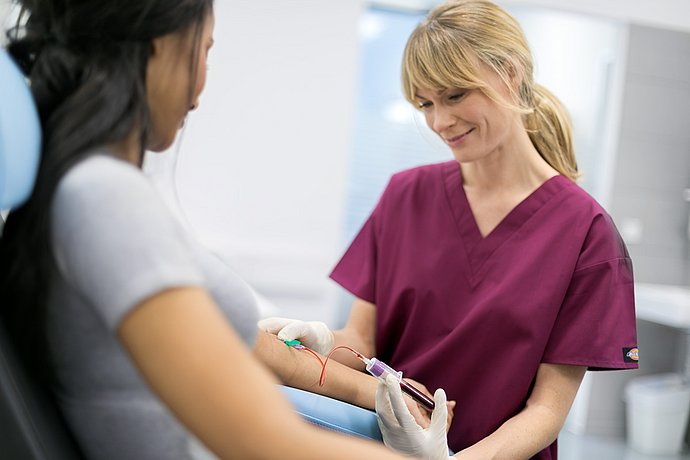
For nurses and phlebotomists, blood collection is part of daily routine. What makes a real difference is not the number of safety features, but how seamlessly they integrate into everyday practice.
Confidence through predictable routines
Caregivers benefit from devices that behave in a predictable and controlled way. Fewer manual steps, instant visible indicators and intuitive activation help build confidence – especially in busy environments.
Safety mechanisms that support focus
Safety solutions work best when they support the caregiver’s natural workflow rather than interrupt it. Semi‑automatic mechanisms and controlled activation can help keep attention where it belongs: on the patient.
Modern safety blood collection sets, such as VACUETTE® EVOPROTECT, are designed with this principle in mind – supporting confident handling through intuitive activation, in‑vein and clear optical feedback during use.
Safety insights for confident blood collection
It is a key concern of ours to inform you about the risk of injury you are exposed to as an employee in the healthcare sector when handling and disposing of these products. unfortunately, potential hazards are often not noticed or taken seriously and those affected attribute too little or sometimes even no significance to injuries caused by a contaminated hypodermic needle.
For patients: why a gentle blood draw matters

From a patient’s perspective, blood collection is often associated with tension and uncertainty – even when it is medically routine. Small details in the procedure can significantly influence how the experience is perceived.
Calm interactions build trust
A steady hand, controlled movements and a calm environment can help patients feel reassured. This is especially important for anxious or pain‑sensitive patients.
Gentle activation supports comfort
Device features that minimize pressure on the skin and reduce movement in the vein can contribute to a gentler experience – supporting both patient comfort and caregiver control.
Product design plays a crucial role here: when safety mechanisms are activated quietly, smoothly and predictably, they can support a calm interaction between caregiver and patient.
3 ways to help patients feel calmer during blood collection
A compact checklist-style infographic can translate the calm pillar into practical, patient-facing behavior.
- Create a reassuring start. Explain the next step clearly and calmly before the procedure begins.
- Support a steady environment. Reduce unnecessary movement, distractions and rushed communication.
- Maintain confidence through the critical moment. Use smooth, predictable handling to support patient comfort and caregiver control.
Want to know more? Read our blog article "3 things to do to calm a patient when taking blood"

From evaluation to results: a safety improvement initiative in practice
At Shannon Medical Center (SMC), nurse and infection prevention expert Kelli Hill set out to further increase the safety of her team. In 2019, the organization observed a concerning rise in needlestick injuries related to winged needle use.
Together with nursing and laboratory management, SMC launched a structured initiative to review both processes and products. The goal was to improve safety without adding complexity to daily routines.
After thorough evaluation, the team decided to introduce the VACUETTE® EVOPROTECT Safety Blood Collection Set. The product was implemented in December 2022 as part of a broader safety and training approach.
The results were clear: SMC reported an 85 % reduction in needlestick injuries. In autumn 2023, the medical center was awarded an “A” grade in the Leapfrog Group’s Hospital Safety Grade – recognizing its strong commitment to patient and staff safety.
The success illustrates how thoughtful product design, clear processes and committed teams can work together to improve safety outcomes in practice.
Safety in Preanalytics and the Significance of Training
Professor Dr. Waleed Al Tamimi, head consultant of the clinical biochemistry lab at the King Abdulaziz Medical City in Saudi Arabia, shares his expertise and experience in converting to using safety products to promote healthcare worker safety and risk management.



Frequently Asked Questions from Clinical Practice
Safety blood collection devices can differ significantly in their activation logic and handling. Design elements such as semi‑automatic mechanisms, side‑button activation or in‑vein protection are intended to support safety and control, but they may initially feel unfamiliar. With repeated use and proper training, these features are designed to integrate naturally into daily routines and support confident handling.
Manual safety mechanisms require the user to actively perform all activation steps, while semi‑automatic systems are designed to reduce manual intervention. A semi‑automatic safety mechanism minimizes activation steps and supports a more predictable and controlled workflow, especially at the end of the blood collection procedure.
In‑vein activation allows the safety shield to be engaged while the needle is still positioned in the vein. This controlled activation supports a steady transition at the end of blood collection and helps caregivers complete the procedure in a calm and predictable way.
Side‑button activation is designed to distribute pressure evenly during activation. By avoiding downward pressure on the skin or vein, it supports stable needle positioning and smooth activation, which can contribute to both caregiver control and patient comfort.
Clear feedback during activation helps confirm that the safety mechanism has been engaged correctly. An audible or tactile signal provides reassurance to the caregiver and supports confidence, particularly in busy or high‑pressure environments.
Some safety blood collection sets are designed to support both standard blood collection and short‑term infusion. Using a single device for multiple applications can help simplify inventories, standardize workflows and reduce the complexity of daily routines.
Confidence develops through a combination of hands‑on training, repeated use and access to clear guidance. Training sessions, application instructions, handling videos and on‑site or remote support can all help teams adapt quickly and safely to new devices.
Training supports more than correct use - it builds confidence, consistency and trust. Structured onboarding and continued support help ensure that safety features are used as intended and become part of routine practice.
Successful evaluation typically includes both technical assessment and practical testing. Involving caregivers, infection prevention teams and laboratory management allows organizations to assess how well a device integrates into existing processes and supports day‑to‑day practice.
Real‑world experience shows that meaningful improvements come from combining thoughtful device design with clear processes and committed teams. When safety solutions support calm routines and intuitive handling, they can contribute to measurable improvements—while allowing caregivers to focus fully on patient care.
See how VACUETTE® EVOPROTECT supports safer handling

VACUETTE® EVOPROTECT is the next stage in blood collection, specifically designed with the highest level of safety in mind, protecting both phlebotomist and patient while ensuring comfort.
The semi-automatic click mechanism protects the user from the risk of needlestick injuries and the ergonomic design makes the daily task of blood collection easier and more intuitive.
VACUETTE® EVOPROTECT provides for gentle collection and safety from injury because we believe that every needlestick is one too many.