Circular Economy

Circular economy and product sustainability
Greiner Bio-One is striving for a circular future in healthcare and life sciences
As a manufacturer of high-quality plastic products for healthcare and research, we embrace the concept of a circular economy to reduce waste and conserve resources. Our circularity initiatives revolve around product design, material reuse, and sustainable packaging, which is tailored to the strict safety and regulatory requirements of the medical and life sciences industries.

The potential to minimize the environmental footprint of laboratories through smarter purchasing decisions is immense. The ACT® Environmental Impact Factor Label was created to meet the needs of both scientists and procurement professionals by providing clear, third-party verified data on the environmental impact of lab products. Greiner Bio-One was one of the first in its industry to adopt the ACT® Environmental Impact Factor label for selected products – serological pipettes and conical tubes.
The Sapphire pipette tips developed by Greiner Bio-One consume 20% less raw material than the previous version. Optimizing the injection molding equipment saves 61 tons of CO2 emissions annually. The tips are not only available in the rack, but also in bags or as refills – versions that use much less packaging. The refill unit's rack inserts are packed in FSC-certified cardboard packaging made from up to 100% recycled material, which saves a significant amount of plastic compared to the full racks and ultimately also saves space and transport emissions. In addition, the inserts themselves are made of 70% recycled material.
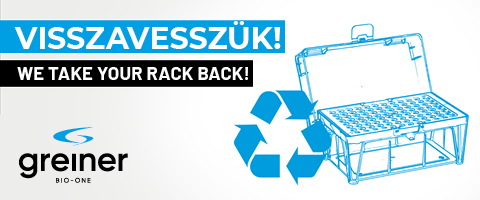
In March 2022, the Mosonmagyaróvár (HU) site launched a rack-back initiative to encourage the reuse and recycling of pipette tip racks. In the lab, racks are often only used once and then disposed of out of habit together with hazardous waste, meaning valuable polypropylene is lost. With the new initiative, Greiner Bio-One Hungary is taking back empty, clean racks and rack inserts. They are collected during regular deliveries to our customers. By December 2025, altogether over 10 000 racks were re-collected from customers. Of this quantity, 2 074 such re-collected racks were provided to customers free of charge.
During the injection moulding process, some product componenents, such as VACUETTE® caps, generate leftover plastic pieces. These are re-milled and fed back into the production process. Other waste from manufacturing at all sites, such as production rejects, is handed over to external partners for recycling.
The Hungarian site has been operating a regranulation plant since 2017. At the plant, clean rejects and polystyrene production waste from two sites are regranulated and fed back into the production process. The material is collected separately and comes directly from production, which ensures a high degree of purity. The system technology used and extensive test procedures ensure that the regranulated polystyrene has the same quality and identical material properties as the original granulate. The recycled material is used for the production of Petri dishes, for example. Greiner Bio-One strives to continuously increase its recycling rate while also minimizing production waste even further.
Due to its properties and range of uses, plastic is often the material of choice in medicine and the laboratory. However, environmental aspects and requirements as well as our ambitious targets present us with new tasks. The issue of the circular economy in particular presents challenges in a medical context.
Due to the areas of application as well as country-specific legal requirements, a large proportion of our products are thermally recycled after use.
These products include, for example, medical devices contaminated with potentially infectious material. The safety of the user and preventing the transmission of diseases are of paramount importance when disposing of them.
Plastic has several properties that are essential for the functionality, safety and performance of the products: shatterproof, lightweight, versatile, visually transparent or non-transparent, and many more. The use of recycled raw materials is difficult because recycled plastics often do not have these properties or meet the purity requirements to the extent required and would, for example, have a negative effect on the reliability of research results.
Despite some challenges, we see opportunities and possibilities that will help us protect our resources. Our intention is to implement activities to work towards a circular economy and, wherever possible, in cooperation with our customers.
Group targets and Greiner Bio-One sustainability performance: Circular economy
| EMISSIONS | 2021 | 2022 | 2023 | 2024 | 2025 | 2026 | 2027 | 2028 | 2029 | 2030 |
|---|---|---|---|---|---|---|---|---|---|---|
| We reduce absolute Scope 3.12 emissions (end-of-life treatment of sold products, base year 2021). | -13.8% | -22.4% | +1.9% | -14% | -25% | |||||
| WASTE | ||||||||||
| We reduce waste sent to landfill to 0 t worldwide. | 1.106 | 1.486 | 1.365 | 1.686 | 1.518 | 0 | ||||
| 75% of our waste is recycled. | 53% | 44% | 45% | 42% | 43% | 75% | ||||
| SUPPLIERS | ||||||||||
| 80% of our suppliers implement science-based targets (measured by GHG emissions of purchased goods and services, Scope 3.1). | 10% | 8% | 80% | |||||||
| 99% of our suppliers (> 500 TEUR) have achieved EcoVadis minimum score (Greiner Group). | 10% | 36% | 41% | 49% | 99% |
