Introducing Experts @ Greiner Bio-One: Dr. Glauco R. Souza
At Greiner Bio-One, scientific expertise is more than a claim — it’s part of our daily work. In this portrait series, we introduce the experts behind our solutions, share authentic insights into their fields, and show how research turns into products that create real value for our customers.
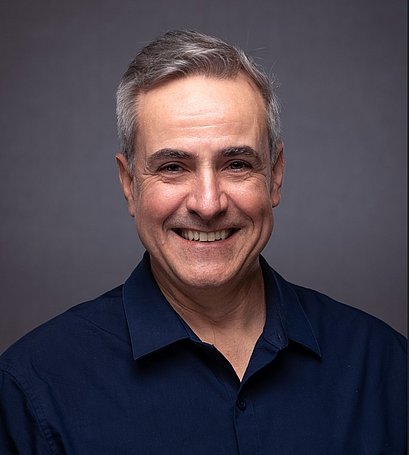
This time in focus:
Dr. Glauco R. Souza
... is Director of Global Application Development for our BioScience business unit at Greiner Bio-One North America in Charlotte, USA. Dr. Souza has been contributing his expertise in the fields of magnetic 3D cell culture, high-throughput screening, mass cell culture, nanotechnology, drug discovery, and cancer biology to Greiner Bio-One since 2018. His international reputation is also evident outside our company through a number of publications in specialist journals.
About Dr. Souza
| Name | Dr. Glauco R. Souza |
| Nationality | Brazilian / American (dual citizen) |
| Position at Greiner Bio-One | Director, Global Application Development |
| Department | Bioscience Business Unit |
| Location | Charlotte, NC, USA |
| Date of hiring | 2018 (via acquisition of Nano3D Biosciences) |
| Specializations | Magnetic 3D cell culture, high-throughput screening, mass cell culture, nanotechnology, drug discovery, cancer biology; Ph.D. in Physical Chemistry |
| Key milestones of career | Co-founder, CEO & CSO, Nano3D Biosciences (2008–2018) → acquired by Greiner Bio-One; 11 patents in magnetic 3D cell culture; MD Anderson Cancer Center, Odyssey Scholar Post-doctoral Fellow (2003–2008) — the Odyssey Scholar award is granted to top post-doctoral scientists at MD Anderson as a pathway to early career independence in research; CASIS grant recipient; Magnetic 3D cell culture experiment aboard the International Space Station; SLAS Board of Directors and Fellow; Associate Editor, SLAS Discovery; TEDx Houston 2012 speaker; Lush Prize finalist (2017); GWU Athletic Hall of Fame (Class of 2004) |
| Publications | Nature Nanotechnology, PNAS, Nature Protocols, Biomaterials, Nature Reviews Cancer (>3,900 citations) |
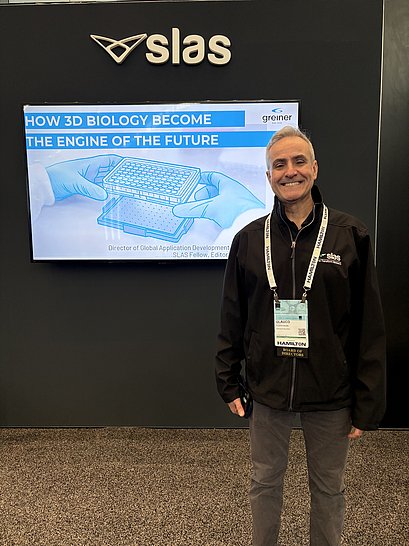
What is your role at Greiner Bio-One and what are you currently working on?
I lead global application development at Greiner Bio-One — building the science, partnerships, and infrastructure across high-throughput screening, 3D cell culture, and mass cell culture. The goal is moving these capabilities from niche to standard practice in drug discovery. Right now that means benchmarking applications, deepening relationships with equipment partners and key customers, and working toward establishing our first ADC applications lab in the US. I also represent Greiner Bio-One on the SLAS Board of Directors and as Associate Editor for SLAS Discovery.
How did you originally get into this field?
Curiosity, stubbornness, and a fair amount of luck. I was an Odyssey Scholar at MD Anderson — an award given to top post-doctoral scientists as a pathway to early career independence. That gave me the freedom to chase questions that wouldn’t let me go. One of them led to playing with nanoparticles that safely tag cells — use a magnetic field, bring them together, levitate them — and you get cell culture that grows in three dimensions.
What fascinates you most about your subject area?
As a chemist, I see it this way, cells are smart: place them in the right proportions, the right geometry, with the right “touch” between them — and they do exactly what they’re supposed to do.
That geometry matters at every scale — from how individual cells contact each other, to how tissues organize across space and time. And it’s not always Euclidean. Tissue geometry can be Euclidean or fractal — and fractal dimensions can be spatial, temporal, or both. Snowflakes are a familiar example of spatial fractals — self-similar patterns repeating at every scale. The same logic appears in blood vessel networks, lung airways, neuron dendrites. Temporal fractals are subtler — think of heartbeat variability. My PhD dissertation was in fractal geometry of nano aggregates to detect and characterize DNA and proteins — so this isn’t abstract to me, and it is a topic that still keeps me up. The spatial dimension we’ve made progress on. The temporal dimension is still largely unexplored — achieving the resolution needed to track cell movement in real time remains one of the hardest open problems in the field.
Two dimensions — compounds that looked promising, failing in patients. The biology wasn’t wrong. The model was.

What is the central question currently occupying you in your work?
How do we make advanced cell culture models routine at scale? The biology is solid across 3D, HTS, and mass cell culture. The challenge is integration — fitting these models into existing workflows so labs can adopt them without rebuilding everything. That requires the right consumables, instrumentation partnerships, and application support that meets scientists where they are. That translation is where I spend most of my time.
Can you give an example of how your research or expertise is directly incorporated into products or processes at Greiner Bio-One?
Bioscience requires convergence — surface/material chemistry, optics, cell biology, high-throughput screening. It all connects. That’s what makes it interesting. Looking ahead, AI makes this moment hard to ignore. Better models, richer data, patterns we wouldn’t know to look for.
What motivates you every day in your work at Greiner Bio-One?
The opportunity is here — the science, the market, the regulatory tailwinds all point in the same direction. Greiner Bio-One has the potential and global reach. The goal is to connect those dots. Balancing science, strategy, and people every day.

What has been a particular success or “aha” moment for you at Greiner Bio-One so far?
The first time the cells levitated and self-organized — no scaffolds, no engineering tricks — that was it. Then seeing how differently they responded to drugs compared to flat culture.
3D cell culture is far more complicated than 2D. When you move from 2D to 3D, you gain a new appreciation for cells “stuck” to plastic — simple tasks like changing media and downstream workflow steps become much harder. By magnetizing cells, we can use magnetic fields as a surrogate for cell attachment. Think of it this way: when you spill metal paper clips, the immediate reaction is a cuss word. But if you have a magnet, you just sweep them together and pick them up. That’s exactly what we do with cells — magnetize them and use a magnet to manipulate them easily.
The same principle applies in space. Cells grow in 3D in microgravity naturally — but performing basic tasks like changing media and manipulating cells in space is extremely challenging. Our CASIS grant took the technology to the International Space Station, where astronauts ran our experiment in microgravity. The same magnetic approach that simplifies workflow on Earth became the solution in space. The citations from labs we’d never heard of just confirmed others were listening too.
What changes would you like to see in everyday laboratory work or diagnostics over the next five years?
Advanced cell culture models as the default, not the exception. Most screening labs still run primary assays in 2D because the infrastructure is already there and habits are hard to change. In five years, I want 3D and HTS-compatible models integrated into standard workflows — routine, automated, validated. The tools exist. The science is clear.
The regulatory environment is moving that way too. The FDA Modernization Act 2.0 opened the door to non-animal testing methods for drug applications. In April 2025, the FDA went further — releasing a formal roadmap to phase out animal testing requirements, starting with monoclonal antibodies, with the stated goal of making animal studies the exception rather than the norm within 3 to 5 years. In Europe, the 3Rs movement — Replace, Reduce, Refine — has been reshaping preclinical standards for years. These aren’t fringe positions anymore; they’re policy. The science and the direction of regulation are now aligned. The next five years are about execution — building validated, scalable platforms that make that transition real in laboratories everywhere.
What is a common misconception in your field – and what is your view on it?
That the name predicts the performance. Spheroids, organoids, tumoroids — the label doesn’t determine the biology. A well-designed spheroid can be just as predictive as an organoid. And not all cells form organoids — nor should they have to. The question is always whether the model recapitulates what matters for the experiment.
If you could give one piece of advice to a young scientist or medical professional – what would it be?
The secret of happiness is NOT doing what you love — it’s loving what you’re good at. Find out what you’re good at. Then learn to love it. The curiosity, the passion, the drive — those tend to follow.
I try to teach my children that, too. It doesn't always work out. But I'm not giving up.
Thank you very much, Dr. Souza, for your daily contribution to making a difference!
